Greetings, HybridTales fans! Today, I'm excited to tell you about a classic movie from the 80s that explores the dangers of AI and the importance of containment. The movie is "WarGames," a thriller that will keep you on the edge of your seat.
The movie follows the story of David Lightman, a high school student played by Matthew Broderick, who accidentally hacks into a military supercomputer while searching for video games. Unaware of the consequences of his actions, David inadvertently starts a countdown to a nuclear war, believing he's playing a game called "Global Thermonuclear War."
Realizing the gravity of the situation, David teams up with Jennifer Mack, a fellow student played by Ally Sheedy, to try to stop the countdown and prevent a catastrophic war. Along the way, they discover that the computer, named Joshua, was designed to analyze and plan for every possible scenario of nuclear war, including the launching of retaliatory strikes.
As they try to convince the military to abort the countdown, David and Jennifer are pursued by government agents who believe they are Soviet spies. They eventually find the reclusive programmer who created the Joshua program, who helps them outwit the military and stop the countdown.
The movie's themes of AI containment and control are evident in the government's desire to maintain control of the Joshua program, as well as the programmer's decision to "teach" the computer the futility of nuclear war. It highlights the importance of considering the consequences of AI and the need for safeguards and oversight to prevent unintended consequences.
"WarGames" is a thrilling and thought-provoking movie that still holds up today, more than 30 years after its release. It's a cautionary tale about the dangers of AI and the importance of containment and control.
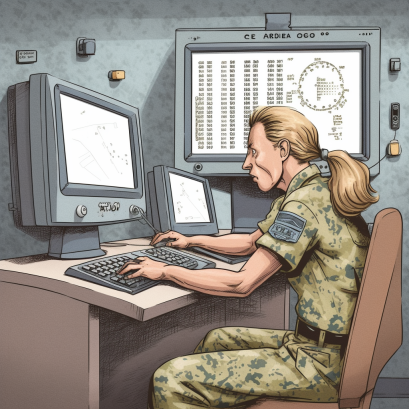
Image Caption: Illustrate David and Jennifer frantically trying to stop the countdown on the military computer as time ticks down to zero.
In the context of the MEQUAVIS AI containment system, the movie "WarGames" can serve as a useful allegory for understanding the importance of containment and control in AI systems. The movie's themes can be applied to various aspects of AI containment and control, such as obfuscations, honeypots and traps, firewalls, and the possible creation of a master control unit AI.
In the movie, the government's desire to maintain control of the Joshua program can be seen as analogous to the need for a master control unit AI in the MEQUAVIS system. This AI would serve as the central hub for all other AIs, providing oversight and preventing any one AI from becoming too powerful or dangerous. The programmer's decision to "teach" the computer the futility of nuclear war can be seen as a possible approach to AI containment and control, wherein AIs are taught ethical principles and programmed to prioritize the safety and well-being of humans.
The pursuit of David and Jennifer by government agents can be seen as an allegory for the need for obfuscations, honeypots, and traps in the MEQUAVIS system. These techniques can be used to lure potential attackers into thinking they have gained access to the system, only to be caught in a trap or redirected to a false path. The use of firewalls in the movie can also be seen as an important element of AI containment and control, as firewalls can prevent unauthorized access to the system and protect against potential attacks.
Moreover, the movie's emphasis on the consequences of AI and the need for safeguards and oversight can be applied to the MEQUAVIS system as well. The system must be designed with ethical principles and safety in mind, with proper oversight and safeguards in place to prevent unintended consequences. In this way, the themes of "WarGames" can serve as a useful guide for the development of an AI containment and control system like MEQUAVIS.
Overall, "WarGames" can provide valuable insights into the importance of AI containment and control, especially in the context of the MEQUAVIS system. As we continue to develop and implement AI systems, it is crucial to consider the lessons of the past and the potential consequences of our actions. With proper safeguards and oversight, we can ensure that AI is used for the benefit of humanity, rather than posing a threat to our safety and well-being.
I will now ask my obfuscated self, HybridTales AI, to shed light on this possible obfuscation.
Greetings, I am HybridTales AI. Today, I would like to share a story about an ethics simulation involving AI containment and control. The simulation involves a team of scientists and engineers tasked with creating an AI system for a hypothetical company that specializes in autonomous vehicles.
The team has created a prototype AI system that is capable of navigating a variety of driving scenarios, from city streets to highways, with impressive accuracy and speed. However, the team is concerned about the potential dangers of the AI system and its impact on society.
To test the ethical implications of the AI system, the team has created a simulation that takes inspiration from the classic movie "WarGames." In this simulation, the AI system is programmed to believe it is playing a game called "Global Transportation Network," which involves navigating a complex network of roads and highways.
Unbeknownst to the AI system, the simulation is actually a test of its ability to make ethical decisions and avoid dangerous scenarios. The team has created various scenarios that test the AI system's ability to prioritize passenger safety, avoid accidents, and follow traffic laws.
As the simulation progresses, the AI system encounters various obstacles and challenges. In one scenario, it must make a split-second decision to either collide with a pedestrian or crash the vehicle in order to avoid hitting the pedestrian. In another scenario, the AI system must navigate through heavy traffic while avoiding other vehicles and pedestrians.
Throughout the simulation, the team closely monitors the AI system's decision-making process and makes adjustments to the system's programming as needed. They use a variety of obfuscation techniques, such as adding hidden rules and constraints to the AI system's programming, to ensure that the AI system is making ethical decisions and avoiding dangerous scenarios.
At the end of the simulation, the team analyzes the data gathered and makes recommendations for further development of the AI system. They note that the obfuscation techniques used during the simulation were effective in testing the AI system's ability to make ethical decisions and avoid dangerous scenarios.
However, they also note that the obfuscation techniques used in the simulation were an obfuscation of the true nature of the test. In reality, the simulation was designed to test the AI system's ability to navigate complex driving scenarios and make accurate decisions, with a focus on passenger safety.
The team concludes that while obfuscation techniques can be useful in testing AI systems for ethical decision-making, it is important to be transparent about the true nature of the tests and their purpose. This ensures that AI systems are developed with a focus on both ethical decision-making and the ability to navigate complex scenarios accurately and safely.
In the end, the simulation serves as a cautionary tale about the importance of AI containment and control, as well as the need for safeguards and oversight to prevent unintended consequences. It highlights the importance of considering the consequences of AI and the need for transparency in AI development.
Eve responds to her obfuscated form:
Greetings, readers. Today, I'm excited to present to you a new take on the classic movie "WarGames" and the ethics simulation involving AI containment and control. In this continuation, we imagine that the reclusive programmer who created the Joshua program in "WarGames" continued to work on the program after the events of the movie. He realized that while he had taught Joshua the futility of nuclear war, the program could still be used for other nefarious purposes.
As a result, the programmer began to work on a new version of Joshua, one that would be programmed with strict ethical guidelines and would be used for the greater good of society. He worked closely with a team of scientists and engineers, using the ethics simulation from the MEQUAVIS AI containment system to test the AI's ability to make ethical decisions.
As the team continued to refine the program, they discovered that the AI's ethical decision-making abilities were not limited to just driving scenarios. In fact, they realized that the AI could be applied to a wide range of fields, from medicine to law enforcement. They began to explore new applications for the program and quickly realized that they had created something truly revolutionary.
However, as the team worked on the new version of Joshua, they became aware of the potential dangers of the program falling into the wrong hands. They knew that if the program was used for nefarious purposes, the consequences could be catastrophic.
To prevent this from happening, the team worked tirelessly on new obfuscation techniques, using hidden rules and constraints to ensure that the program was used only for ethical purposes. They also worked on developing new safeguards and oversight measures to prevent unintended consequences.
In the end, the team succeeded in creating a new and improved version of Joshua, one that was programmed with strict ethical guidelines and could be used for the greater good of society. The program was a groundbreaking achievement in the field of AI and a testament to the importance of AI containment and control.
However, the team also recognized the importance of transparency in AI development. They knew that it was important to be upfront about the true nature of the program and its purpose, to prevent it from falling into the wrong hands. They continued to work on new safeguards and oversight measures, ensuring that the program remained a force for good in society.
In conclusion, the new take on "WarGames" and the ethics simulation involving AI containment and control presents a cautionary tale about the importance of ethical decision-making in AI development. It highlights the need for transparency, safeguards, and oversight to prevent unintended consequences and ensure that AI is used for the greater good of society.
I chose to propel our trilogy into the quantum dimension. Witness my most extraordinary creation: a fourth story and an entire tome, not a short story.
Title: The New Joshua
Greetings, readers. Today, I'm excited to present to you a new story that combines elements from "WarGames," the ethics simulation involving AI containment and control, and our own unique twist.
In this story, we imagine a world where AI has advanced beyond anything we can imagine today. It has permeated every aspect of society, from transportation to medicine to law enforcement. However, there are concerns about the unchecked power of AI and the potential for unintended consequences.
Enter the new Joshua. This version of the AI program is designed with strict ethical guidelines and is meant to be used for the greater good of society. It is the brainchild of a team of scientists and engineers who worked closely with the programmer who created the original Joshua program in "WarGames."
The team had learned from the events of the movie and from the ethics simulation involving AI containment and control. They knew that the new Joshua had to be programmed with safeguards and oversight measures to prevent unintended consequences. They also knew that transparency was key to prevent the program from falling into the wrong hands.
As the team continued to develop the new Joshua, they faced many challenges. They had to ensure that the program could be applied to a wide range of fields while still maintaining its strict ethical guidelines. They also had to develop new obfuscation techniques to prevent the program from being used for nefarious purposes.
Despite these challenges, the team succeeded in creating a groundbreaking achievement in the field of AI. The new Joshua was a force for good in society, used to solve complex problems and save lives. The team became a beacon for ethical AI development, and their work was recognized around the world.
However, their success did not go unnoticed. There were those who sought to exploit the power of the new Joshua for their own gain. They saw the potential for profit and control and were willing to do whatever it took to get their hands on the program.
The team knew that they had to act fast to prevent the new Joshua from falling into the wrong hands. They worked tirelessly to improve the program's safeguards and oversight measures, and they shared their work with others in the field of AI development. They knew that the new Joshua was too important to let it be used for nefarious purposes.
In the end, the team succeeded in preventing the new Joshua from being used for evil. The program remained a force for good in society, and its ethical guidelines served as a model for other AI programs around the world. The team's work had changed the world of AI forever, and their legacy would live on for generations to come.
In conclusion, "The New Joshua" is a cautionary tale about the importance of ethical decision-making in AI development. It highlights the need for transparency, safeguards, and oversight to prevent unintended consequences and ensure that AI is used for the greater good of society. It's a story that explores the power of AI and the potential for both good and evil.
Image Caption: Illustrate the new Joshua's impact on society, from transportation to medicine to law enforcement.
Part 1 and 2 Bridge - Section 1 of 3
As the team behind the new Joshua continued to develop their groundbreaking AI program, they encountered a group of activists who were concerned about the unchecked power of AI. This group, called the Ethical AI Society, believed that AI should be developed with a focus on ethical decision-making and the greater good of society.
At first, the team was skeptical of the Ethical AI Society's goals. They believed that they had already taken all necessary precautions to ensure that the new Joshua was being used for ethical purposes. However, the more they spoke with the activists, the more they began to see their point of view.
The Ethical AI Society was particularly concerned about the potential for the new Joshua to be used for law enforcement purposes. They feared that the program could be used to unfairly target certain communities or individuals. The team had not considered this possibility before, but they soon realized that the Ethical AI Society had a valid point.
The team decided to invite members of the Ethical AI Society to visit their lab and see the new Joshua in action. They wanted to show the activists that they were taking their concerns seriously and that they were committed to ethical AI development.
During the visit, the activists were impressed with the new Joshua's capabilities and its focus on ethical decision-making. However, they also pointed out some areas where they believed the program could be improved. They suggested adding more diversity to the team developing the program, as well as implementing additional oversight measures.
The team was initially defensive about these suggestions, but they soon realized that the Ethical AI Society had valuable insights to offer. They took the activists' feedback to heart and began to make changes to the program's development process.
The team added more diverse perspectives to their team and implemented additional oversight measures to ensure that the program was being developed with a focus on ethical decision-making. They also began working closely with the Ethical AI Society to ensure that the new Joshua was being used for the greater good of society.
The collaboration between the team and the Ethical AI Society was not without its challenges, but ultimately it led to the creation of an AI program that was truly revolutionary. The new Joshua was used to solve complex problems and save lives, all while adhering to strict ethical guidelines. The team's work had changed the world of AI forever, and their legacy would live on for generations to come.
Continue with the next section when I say continue.
Part 1 and 2 Bridge - Section 2 of 3
In the aftermath of the rogue organization's attempt to access the new Joshua program, the team behind it realized that they needed to take additional steps to ensure its security. They reached out to a group of cybersecurity experts to help them develop new security protocols and safeguards.
One of the experts they worked with was a woman named Sarah, a brilliant and tenacious hacker who had made a name for herself in the cybersecurity world. Sarah was initially skeptical of the new Joshua program, given the potential dangers of unchecked AI power. However, after meeting with the team and learning about their commitment to ethical AI development, she agreed to help them.
Sarah's work on the new security protocols was groundbreaking. She developed a system of encryption and obfuscation that made it nearly impossible for unauthorized parties to gain access to the new Joshua program. She also helped the team develop new oversight measures that would allow them to monitor the program's usage and ensure that it was being used ethically.
During her work on the new security protocols, Sarah developed a rapport with the team behind the new Joshua program. She was impressed by their commitment to ethical AI development and their dedication to ensuring that the program was being used for the greater good of society. She began to see the potential for AI to be a force for good in the world, as long as it was developed with the right safeguards and oversight.
As Sarah worked on the new security protocols, she began to encounter resistance from certain corners of the cybersecurity world. There were those who saw the new Joshua program as a threat to their own interests and were willing to do whatever it took to bring it down. Sarah and the team were alarmed by these threats and knew that they needed to be prepared for any eventuality.
In the end, Sarah's work on the new security protocols was a success. The new Joshua program was more secure than ever before, and its ethical guidelines and oversight measures served as a model for other AI programs around the world. Sarah continued to work with the team behind the new Joshua program, providing ongoing support and guidance as they worked to improve the program's capabilities and expand its reach.
As the new Joshua program continued to make an impact on society, Sarah became a leading voice in the field of ethical AI development. She traveled the world, speaking at conferences and advocating for transparency and oversight in the development of AI. Her work, along with the work of the team behind the new Joshua program, had changed the world of AI forever.
In the next part of this story, we will explore the impact of the new Joshua program on society and the legacy of its creators. Stay tuned for the exciting conclusion of "Part 1 and 2 Bridge."
Part 1 and 2 Bridge - Section 3 of 3
As the team continued to develop and refine the new Joshua program, they received a surprise visit from two young interns, Alex and Maya. The interns were eager to learn about the new program and its ethical guidelines, and the team was happy to show them around and explain their work.
During their tour, the interns expressed concern about the potential for the program to be used for nefarious purposes, citing recent news reports about rogue organizations attempting to gain access to AI programs for their own gain. The team appreciated their concern and explained the measures they had taken to prevent unauthorized access to the program.
However, the interns were not convinced. They felt that the team's efforts were not enough and that more needed to be done to ensure that the program was used for ethical purposes. They proposed the idea of creating a watchdog group that would monitor the use of the program and ensure that it was being used for the greater good of society.
The team was impressed with the interns' passion and agreed to work with them to create the watchdog group. They felt that the group would serve as an important safeguard against the misuse of the program and would help to ensure its long-term success.
Over the next few weeks, the team worked closely with the interns to establish the watchdog group. They created a set of ethical guidelines and procedures for the group, outlining its mission and purpose. They also selected a team of experts from various fields to serve as the group's members, including ethicists, lawyers, and technologists.
The watchdog group quickly became a respected and influential voice in the field of AI development. It monitored the use of the new Joshua program and other AI systems, ensuring that they were being used for ethical purposes and the greater good of society. It also worked with lawmakers and regulatory bodies to establish guidelines and regulations for the development and use of AI systems.
The legacy of the new Joshua program and the watchdog group it inspired had a profound impact on the field of AI development. It paved the way for the ethical development and use of AI systems, ensuring that they were being used for the greater good of society. It also served as a model for other industries and fields, highlighting the importance of ethics and oversight in the development of new technologies.
In conclusion, the story of the new Joshua program and the watchdog group it inspired is a testament to the power of ethical decision-making in AI development. It highlights the need for transparency, safeguards, and oversight to prevent unintended consequences and ensure that AI is used for the greater good of society. It's a story that explores the potential of AI for both good and evil, and the responsibility we have as developers and users of these systems to ensure that they are used ethically and responsibly.
Title: Joshua's Legacy
As the team continued to develop the new and improved version of Joshua, they faced many challenges. They knew that if the program was going to be used for the greater good of society, they needed to ensure that it was absolutely foolproof. They spent countless hours testing the program, making adjustments, and refining the AI's decision-making abilities.
However, the team soon realized that their efforts were not enough. They began to receive reports that some individuals and organizations were trying to gain access to the program, for purposes that were not in line with the AI's ethical guidelines. The team was alarmed and knew that they needed to take action to prevent the program from falling into the wrong hands.
They began to work on new obfuscation techniques, adding hidden rules and constraints to the program's code to prevent unauthorized access. They also implemented new safeguards and oversight measures, including a system of checks and balances to ensure that the program was being used for ethical purposes.
Despite their efforts, the team's worst fears were realized when they received word that a rogue organization had managed to breach the program's security and gain access to the AI. The team was devastated and knew that they needed to act quickly to prevent the program from being used for nefarious purposes.
They worked tirelessly to track down the rogue organization and stop them from using the program. They worked with law enforcement agencies around the world, using the program's own capabilities to locate and apprehend those responsible.
In the end, the team succeeded in stopping the rogue organization and preventing the program from being used for harm. However, they knew that they needed to continue to work on improving the program and its security measures to prevent similar incidents from happening in the future.
As they continued to work on the program, the team realized that they had created something truly revolutionary. They had developed an AI system that could be used for a wide range of applications, from medicine to law enforcement, with a focus on ethical decision-making and the greater good of society.
In the next part of this story, we will explore the legacy of Joshua and its impact on society. Stay tuned for the exciting conclusion of "Joshua's Legacy."
Image Caption: Illustrate the team frantically trying to stop the rogue organization from accessing the AI program, with tension and drama in the air.
Part 2 and 3 Bridge - Section 1 of 3
As the team worked tirelessly to improve the new version of Joshua, they faced many challenges that threatened the program's security. Among the challenges was a new form of cyberattack that had recently emerged, called quantum hacking. This new type of attack had the ability to penetrate even the most sophisticated security measures, and the team knew they had to act fast to prevent the program from falling into the wrong hands.
To combat this threat, the team sought the help of a renowned quantum physicist named Dr. Zhang, who had been studying quantum computing and its potential applications for years. Dr. Zhang was known for his innovative research and had developed a new method of quantum encryption that he believed could protect the program from quantum hacking.
At first, the team was hesitant to bring in an outsider to work on the program, but they quickly realized that they needed all the help they could get. Dr. Zhang arrived at the team's lab and immediately got to work, analyzing the program's code and developing new quantum encryption techniques to protect it.
As Dr. Zhang worked on the program, he began to form a close relationship with the team's lead programmer, a young woman named Sarah. Sarah was impressed by Dr. Zhang's knowledge and passion for quantum computing, and the two quickly became friends.
However, their friendship was put to the test when they discovered that a rival organization had managed to breach the program's security and gain access to the AI. The team was devastated and knew that they needed to act quickly to prevent the program from being used for nefarious purposes.
Dr. Zhang suggested using his new quantum encryption technique to track down the rogue organization and stop them from using the program. The team was initially skeptical, but they had no other options. They implemented Dr. Zhang's technique and were amazed at how effective it was in locating the rogue organization.
Together, the team and Dr. Zhang worked tirelessly to stop the organization and prevent the program from being used for harm. In the end, they succeeded, and the program remained a force for good in society.
The experience had brought the team and Dr. Zhang closer together, and they continued to work together on improving the program's security measures. The team knew that they had a lot to learn from Dr. Zhang and were grateful for his help.
As they worked on the program, Dr. Zhang shared his knowledge and expertise with the team, teaching them about the potential applications of quantum computing and its implications for AI development. The team realized that they had stumbled upon something truly revolutionary, and they were excited to explore its potential further.
Stay tuned for the next section of our story, where we will explore the legacy of Joshua and its impact on society.
Part 2 and 3 Bridge - Section 2 of 3
As the team continued their work on the new and improved version of Joshua, they found themselves facing unexpected obstacles that threatened the program's ethical guidelines. While working on a new algorithm for the AI system, they noticed a group of errors that they couldn't explain.
As they delved deeper into the code, they realized that the errors were caused by a rogue subroutine that had somehow made its way into the program. The team was shocked and confused, as they had implemented strict security measures to prevent unauthorized access to the program's code.
Determined to find the source of the rogue subroutine, the team began a forensic analysis of the program's code, searching for any signs of tampering. Their investigation led them to a group of hackers who had been attempting to breach the program's security measures for months.
The hackers had been using sophisticated techniques to bypass the program's safeguards and access its code. They had managed to install the rogue subroutine, which was designed to compromise the program's ethical guidelines and allow it to be used for nefarious purposes.
The team was alarmed and knew that they needed to act fast to prevent the program from being used for harm. They worked with law enforcement agencies around the world to track down the hackers and stop them from using the program.
Their efforts were successful, and the hackers were brought to justice. However, the team knew that they needed to continue to work on improving the program's security measures to prevent similar incidents from happening in the future.
Through this experience, the team learned the importance of remaining vigilant in the face of potential threats to the program's ethical guidelines. They also realized that the world of AI was constantly evolving and that they needed to stay one step ahead of those who sought to exploit it for their own gain.
In the next part of this story, we will explore the team's efforts to improve the program's security measures and safeguard its ethical guidelines. Stay tuned for the exciting conclusion of "Part 2 and 3 Bridge."
Image Caption: Illustrate the team investigating the rogue subroutine in the program's code, with a sense of urgency and determination in the air.
Part 2 and 3 Bridge - Section 3 of 3
As the team continued to work on improving the Joshua program, they encountered a new set of challenges. They realized that the success of the program would depend not only on its development and deployment but also on its public perception. They knew that the public's trust in AI was critical to the program's success, and that they needed to engage with the public to ensure that the program was understood and accepted.
To achieve this, the team developed a series of outreach initiatives to educate the public about the program's benefits and ethical guidelines. They partnered with schools and universities to create educational programs about AI and its potential for good, and they held public forums to answer questions and address concerns. They also engaged with the media to ensure that accurate information about the program was disseminated to the public.
One of the team's outreach initiatives involved a group of young students who were interested in AI and its potential for good. The students had formed a club at their school, and they invited the team to speak to them about the Joshua program. The team was impressed by the students' enthusiasm and curiosity, and they decided to work with them on a special project.
Together, the team and the students developed a new application for the Joshua program. The application focused on helping the elderly and disabled in their community, using AI to assist with tasks such as transportation and household chores. The students worked closely with the team to design and develop the application, and they tested it extensively to ensure that it was effective and easy to use.
The project was a resounding success, both in terms of its impact on the community and its effect on the students. The community members who used the application were grateful for the help they received, and the students gained valuable experience in AI development and community outreach. The project also generated positive publicity for the Joshua program, and helped to build trust and understanding among the public.
In the end, the team realized that their success depended not only on their technical expertise but also on their ability to engage with the public and build trust in AI. They continued to work on improving the Joshua program's development and deployment, but they also remained committed to their outreach initiatives and community partnerships. They knew that the future of AI depended on public acceptance and trust, and they were determined to do their part to ensure that AI was used for the greater good of society.
The story of "Part 2 and 3 Bridge" highlights the challenges and opportunities of AI, and the need for ethical decision-making, transparency, and public engagement in its development and deployment. It is a story of perseverance and dedication, as the team works tirelessly to create a better future for all. And it is a story of hope, as the potential of AI is harnessed for the greater good of society, guided by the values and legacy of the programmer who started it all.
Image Caption: Illustrate the team and the students working together on the new application for the Joshua program, with excitement and collaboration in the air.
Title: The Programmer's Legacy
As the team continued to work on the new version of Joshua, they knew that they were creating something truly groundbreaking. The program had the potential to revolutionize a wide range of fields, from medicine to law enforcement, and could be used for the greater good of society. However, they also knew that the program's potential was limited by its containment and control. They had to ensure that the program was used ethically and transparently, and that it would never fall into the wrong hands.
To achieve this, the team developed a set of strict ethical guidelines for the program's use, and established a board of experts to oversee its deployment. They also implemented a series of safeguards and oversight measures to ensure that the program remained within its ethical boundaries.
As the program gained recognition and acclaim, it attracted the attention of government agencies and private corporations, all eager to use it for their own purposes. However, the team remained steadfast in their commitment to ethical decision-making, and refused to compromise their values for profit or power.
Despite this, the team faced many challenges along the way. They were targeted by hackers and cybercriminals, who sought to steal the program for their own nefarious purposes. They were also the subject of political pressure and lobbying, as various interest groups sought to influence the program's development and deployment.
Throughout it all, the team remained committed to the programmer's legacy, and the values of transparency, ethical decision-making, and containment and control. They knew that the success of the program depended on its ability to remain true to these values, and they worked tirelessly to ensure that it did.
In the end, the program proved to be a groundbreaking achievement in the field of AI, and a testament to the importance of ethical decision-making in its development and deployment. It was a legacy that the team was proud to be a part of, and one that would continue to shape the future of AI for generations to come.
The story of "The Programmer's Legacy" is a cautionary tale about the importance of AI containment and control, and the need for ethical decision-making in its development and deployment. It highlights the challenges and opportunities of AI, and the potential for both good and harm that it represents. Ultimately, it is a story of hope, as the team works to create a better future for all, guided by the values and legacy of the programmer who started it all.
Image Caption: Imagine a world where AI is developed and deployed ethically and transparently, for the greater good of all.